Mining, gas and hydrocarbons
Mining and mineral resources
As the world's second-largest manganese producer, Gabon draws its second major export resource, after oil, from its subsoil. Output is dominated by Comilog, an Eramet subsidiary, at Moanda. The country is preparing a ban on raw manganese exports from 2029 and the development of the Belinga iron ore deposit, while gold is still mined on a small scale.
- National manganese production
- 9.44million tonnes (-5.3% year on year)
- National manganese production
- 9.1million tonnes (-2.5% year on year)
- Moanda mine output (Comilog)
- 7.1million tonnes (+4%)
Detailed sources in the key figures below.
Key figures
Mining key figures
National manganese production
9.44 million tonnes (-5.3% year on year)
2024
National manganese production
9.1 million tonnes (-2.5% year on year)
2025
Moanda mine output (Comilog)
7.1 million tonnes (+4%)
2025
Ore transported by Comilog
6.1 million tonnes
2025
Ore sold externally by Comilog
5.5 million tonnes
2025
Manganese sector turnover
797.9 billion CFA francs
2024
Historical resource estimate of the Belinga iron ore deposit
1 billion tonnes
Estimation historique
ROG gold refinery capacity
7 to 10 tonnes of gold a year (joint venture between Société équatoriale des mines and Alpha Centauri Mining)
depuis juin 2023
Indicated niobium pentoxide resource at the Maboumine deposit
2.3 million tonnes at 1.2% Nb₂O₅ (world's second-largest niobium reserve)
Estimation Eramet
Niobium output targeted by the Maboumine feasibility study
14,500 tonnes a year (about 3 million tonnes of ore mined annually)
Étude de faisabilité
Gold exports
+183.7 % in 2024, to EUR 103.7 million (4th-largest export product, BEAC data)
2024
Statistical series
Manganese ore production
7,103.0 kt
2025
Source: Eramet (Comilog)
Mineral rents
0.0 % of GDP
2021
Source: World Bank
23.3 %
2023
Source: World Bank
Locations
- 2 provinces
- Haut-Ogooué, Ogooué-Ivindo
Source: OCHA / Institut national de cartographie du Gabon (CC BY-IGO)
Provinces of the listed sites: mine.
Trends
Manganese: three years of decline, then a recovery
According to the Ministry of the Economy, cited by Gabonmediatime, national manganese output fell 5.3% in 2024 to 9.44 million tonnes, for turnover of 797.9 billion CFA francs, as a 9.9% rise in the average selling price limited the revenue decline. For 2025, the Directorate General for the Economy and Fiscal Policy (DGEPF) reports a further 2.5% drop to about 9.1 million tonnes according to Financial Afrik, a third year of decline. The reasons given are mainly logistical: slower traffic on the Transgabonais railway during upgrade works, ageing facilities at Ndjolé, evacuation constraints at the port of Owendo and delays in granting mining permits for the Biniomi and Bordeaux sites.
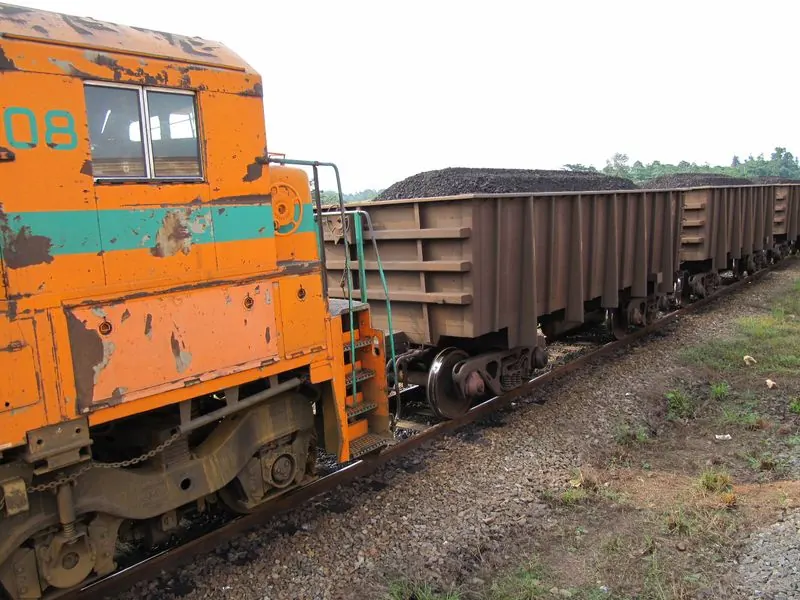
For Comilog, Eramet reports that output at the Moanda mine rose 4% in 2025 to 7.1 million tonnes, but that transported volumes (6.1 million tonnes) and external sales (5.5 million tonnes) remained at historically low levels, held back in the first half by difficulties at the port of Owendo and on the railway. Rail remains one of the main bottlenecks in the logistics chain. The trend improved later on: national output rose 10.8% quarter on quarter in the fourth quarter of 2025, then 8.4% in the first quarter of 2026 according to Gabonmediatime, despite the shutdown of the Okondja site since November 2025. In the first quarter of 2026, according to Gabonmediatime, Comilog transported 1.6 million tonnes, up 16% year on year, and Eramet targets 6.4 to 6.8 million tonnes transported over the year.
Raw ore exports to end
On 30 May 2025 the Council of Ministers decided to ban raw manganese exports from 1 January 2029, with a transition period for operators to invest in processing units and training centres. Announced support measures include a public-private investment fund, targeted tax incentives, a national training programme and stronger energy infrastructure. Eramet says it continues studies and discussions with the authorities on ore processing options, with a view to a joint roadmap.
Iron, gold and logistics
The Belinga iron ore deposit in Ogooué-Ivindo, discovered in 1955, is, according to Agence Ecofin, a joint venture between Fortescue, which holds about 72%, and the State. A first cargo was exported in December 2023 to demonstrate the project's viability. In December 2025 Fortescue's chairman and the head of State reaffirmed the goal of first ore on ship at scale by 2030, which requires an integrated mine, rail and port solution. Gold, mined at about two tonnes a year according to a 2020 estimate, saw exports drop 75% in the first quarter of 2026 according to Gabonmediatime.
In November 2025 the State signed the Transgabonais modernisation and security programme, worth EUR 203 million (a EUR 173 million loan from the French Development Agency and a EUR 30 million grant from the European Union), which is to make the railway linking the port of Owendo to the mining areas more reliable.
Niobium and rare earths: the Maboumine project relaunched
The Maboumine deposit, near Lambarene (Moyen-Ogooue), is presented by Gabonreview as the world's second-largest niobium reserve, with an indicated resource of 2.3 million tonnes of niobium pentoxide (Nb2O5) at 1.2% and a rare-earth resource of 2 million tonnes of oxides, according to Eramet-Comilog estimates. On 16 February 2026, the Gabonese company New Energy Metals Holdings (NEM) and Indonesian state-owned PT Perminas, a subsidiary of the Danantara sovereign wealth fund, signed a memorandum of understanding in Libreville for exploration and development of the deposit, including downstream processing (separation, refining, metal and permanent magnet production) planned in Indonesia. According to Gabonreview, pilot projects are expected between 2026 and 2027.
Gold: suspension lifted and production restarted
According to Direct Infos Gabon, citing the Bank of Central African States (BEAC), gold exports jumped 183.7% in 2024 to EUR 103.7 million, making gold the country's fourth-largest export product. Between 2022 and 2023, raw gold shipments fell 80.7% as the Gabon Gold Refinery (ROG) redirected supplies towards local processing rather than raw ore exports. On 7 September 2026, the Minister of Mines and Geological Resources lifted the nationwide suspension on gold mining, following a national census of operators carried out in November 2025 and internal and external audits. A new operating agreement covering the Baniaka and Koumba mines (160 km2, Ngounie province) was signed with Societe equatoriale des mines (SEM).
Manganese ore production
Manganese ore production (Gabon) went from 3,201.0 kt in 2010 to 7,103.0 kt in 2025. The highest value was reached in 2022 (10,375.0 kt).
| Period | Manganese ore production (kt) |
|---|---|
| 2010 | 3,201.0 |
| 2011 | 4,070.0 |
| 2012 | 3,637.0 |
| 2013 | 4,297.0 |
| 2014 | 4,081.0 p |
| 2015 | 4,112.0 p |
| 2016 | 3,379.0 p |
| 2017 | 4,717.0 |
| 2018 | 5,071.0 p |
| 2019 | 6,169.0 p |
| 2020 | 7,326.0 |
| 2021 | 7,320.0 e |
| 2022 | 10,375.0 |
| 2023 | 9,968.0 |
| 2024 | 6,803.0 |
| 2025 | 7,103.0 |
p: provisional; e: estimate.
Provisional or estimated values are drawn with dashed lines.
Mineral rents
Mineral rents (Gabon) went from 0.0 % of GDP in 1970 to 0.0 % of GDP in 2021. The highest value was reached in 2013 (0.1 % of GDP).
| Period | Mineral rents (% of GDP) |
|---|---|
| 1970 | 0.0 |
| 1971 | 0.0 |
| 1972 | 0.0 |
| 1973 | 0.0 |
| 1974 | 0.0 |
| 1975 | 0.0 |
| 1976 | 0.0 |
| 1977 | 0.0 |
| 1978 | 0.0 |
| 1979 | 0.0 |
| 1980 | 0.0 |
| 1981 | 0.0 |
| 1982 | 0.0 |
| 1983 | 0.0 |
| 1984 | 0.0 |
| 1985 | 0.0 |
| 1986 | 0.0 |
| 1987 | 0.0 |
| 1988 | 0.0 |
| 1989 | 0.0 |
| 1990 | 0.0 |
| 1991 | 0.0 |
| 1992 | 0.0 |
| 1993 | 0.0 |
| 1994 | 0.0 |
| 1995 | 0.0 |
| 1996 | 0.0 |
| 1997 | 0.0 |
| 1998 | 0.0 |
| 1999 | 0.0 |
| 2000 | 0.0 |
| 2001 | 0.0 |
| 2002 | 0.0 |
| 2003 | 0.0 |
| 2004 | 0.0 |
| 2005 | 0.0 |
| 2006 | 0.0 |
| 2007 | 0.0 |
| 2008 | 0.0 |
| 2009 | 0.0 |
| 2010 | 0.0 |
| 2011 | 0.0 |
| 2012 | 0.1 |
| 2013 | 0.1 |
| 2014 | 0.1 |
| 2015 | 0.1 |
| 2016 | 0.1 |
| 2017 | 0.1 |
| 2018 | 0.0 |
| 2019 | 0.0 |
| 2020 | 0.0 |
| 2021 | 0.0 |
Ores and metals share of merchandise exports
Ores and metals share of merchandise exports (Gabon) went from 17.6% in 1962 to 23.3% in 2023. The highest value was reached in 1966 (40.1%).
| Period | Ores and metals share of merchandise exports (%) |
|---|---|
| 1962 | 17.6 |
| 1963 | 28.6 |
| 1964 | 30.8 |
| 1965 | 37.0 |
| 1966 | 40.1 |
| 1967 | 33.9 |
| 1968 | 26.9 |
| 1969 | 25.4 |
| 1970 | 13.7 |
| 1971 | 22.1 |
| 1975 | 10.2 |
| 1976 | 12.2 |
| 1977 | 9.3 |
| 1978 | 18.3 |
| 1979 | 13.1 |
| 1980 | 12.1 |
| 1981 | 5.3 |
| 1982 | 5.1 |
| 1983 | 7.0 |
| 1993 | 6.1 |
| 1994 | 3.4 |
| 1996 | 2.0 |
| 1997 | 5.7 |
| 1998 | 2.7 |
| 1999 | 2.3 |
| 2000 | 1.7 |
| 2001 | 1.5 |
| 2002 | 1.8 |
| 2003 | 1.1 |
| 2004 | 5.5 |
| 2005 | 3.6 |
| 2006 | 3.2 |
| 2007 | 3.6 |
| 2008 | 2.2 |
| 2009 | 3.0 |
| 2010 | 2.5 |
| 2011 | 3.9 |
| 2012 | 1.2 |
| 2013 | 1.4 |
| 2014 | 1.1 |
| 2015 | 1.6 |
| 2016 | 1.8 |
| 2017 | 3.3 |
| 2018 | 3.1 |
| 2019 | 4.3 |
| 2020 | 6.2 |
| 2021 | 6.8 |
| 2022 | 6.4 |
| 2023 | 23.3 |
Main players
Main mining players
| Name | Activity | Location |
|---|---|---|
| Compagnie minière de l'Ogooué (Comilog), Eramet group | Manganese mining, 7.1 million tonnes in 2025; the State holds nearly one third of the capital | Moanda (Haut-Ogooué) |
| Moanda Metallurgical Complex (Eramet) | Manganese processing, plant opened in 2015 | Moanda (Haut-Ogooué) |
| Nouvelle Gabon Mining (NGM) | Manganese mining and processing, capacity of 2.4 million tonnes a year; ferroalloy smelter project at Mounana | Franceville, Okondja, Mounana (Haut-Ogooué) |
| Compagnie industrielle et commerciale des mines de Huazhou (CICMHZ) | Manganese mining, Chinese-owned | Ndjolé (Moyen-Ogooué) |
| Ivindo Iron (Fortescue and the Gabonese State) | Belinga iron ore project | Belinga (Ogooué-Ivindo) |
| Transgabonais railway | 648 km railway between Libreville (Owendo) and Franceville, carrying ore | Estuaire, Moyen-Ogooué, Ogooué-Ivindo, Ogooué-Lolo, Haut-Ogooué |
| Ministry of Mines and Geological Resources | Oversight, mining titles, local processing policy | Libreville |
| New Energy Metals Holdings (NEM) and PT Perminas | February 2026 memorandum of understanding for exploration and development of the Maboumine niobium and rare-earth deposit | Maboumine, near Lambaréné (Moyen-Ogooué) |
| Gabon Gold Refinery (ROG) | Gold refining, capacity of 7 to 10 tonnes a year; joint venture between the state-owned Société équatoriale des mines and Alpha Centauri Mining, operating since June 2023 | Nkok special economic zone (Estuaire) |
Regulatory framework
Mining is governed by the mining code (Law No. 037/2018 of 11 June 2019), which replaced the 2015 law. It sets the legal, tax and customs regimes for prospecting, exploration and mining, distinguishes artisanal mining, quarries and mines (small-scale, large-scale or tailings permits) and includes specific provisions on precious and strategic substances and on mining's contribution to local development. According to the French Treasury, it provides for a free 10% State stake in new projects.
The Council of Ministers decision of 30 May 2025 sets 1 January 2029 as the start of the ban on exporting unprocessed manganese. Mining projects are subject to the 2014 environmental protection law, which requires an impact assessment. Resident mining companies apply the 2021 CEMAC regulation on foreign exchange rules in the extractive sector, and sector payments are covered by Extractive Industries Transparency Initiative (EITI) reports.
Reference texts
-
Mining code
Loi n° 037/2018 du 11 juin 2019 portant réglementation du secteur minier en République gabonaise
-
Environmental protection law
Loi n° 007/2014 du 01 août 2014 relative à la protection de l'environnement en République gabonaise
-
Regulation on how resident extractive companies apply certain foreign exchange rules
Règlement n° 01/CEMAC/UMAC/CM, fait à Douala le 23 décembre 2021
Opportunities
- Manganese processing. The 2029 deadline creates a need for beneficiation and ferroalloy units (ferromanganese, silicomanganese), following the example of the Moanda complex or NGM's smelter project at Mounana. The government has announced a public-private fund and dedicated tax incentives.
- Power for metallurgy. Smelters use large amounts of electricity; hydro or gas-fired generation is a precondition for local processing.
- Mining logistics. The Transgabonais modernisation, better port capacity at Owendo and the Belinga mine, rail and port solution open markets for works, equipment and services.
- Belinga iron ore. Developing the deposit, targeted for 2030, will require heavy investment in infrastructure and subcontracting.
- Exploration. Exploration licences have been granted for copper, gold, diamonds and other minerals in a subsoil that is still little mapped.
Take the next step
These opportunities translate into concrete formalities: find the ones that apply to your project, or ask the assistant.
Documents
-
Eramet, 2025 full-year results (press release), PDF format (opens in a new tab)
Eramet
-
DGEPF, sector business cycle note for the fourth quarter of 2025 (in French), PDF format (opens in a new tab)
Direction générale de l'économie et de la politique fiscale
-
Gabon 2023 EITI report, HTML format (opens in a new tab)
ITIE Gabon
-
Gabon 2022 EITI report, HTML format (opens in a new tab)
ITIE Gabon
-
IMF, 2024 Article IV consultation (Country Report No. 24/144), PDF format (opens in a new tab)
Fonds monétaire international
-
AFD, Transgabonais modernisation and security programme, HTML format (opens in a new tab)
Agence française de développement
-
Country commercial guide: mining, HTML format (opens in a new tab)
International Trade Administration
Sources
24 sources cited
Documents and datasets used for this profile.
- Gabon : la production de manganèse recule de 5,3 % en 2024 malgré la résistance des prix (opens in a new tab)
- Gabon : pour la troisième année consécutive, la production nationale de manganèse recule de 2,5 % en 2025 (opens in a new tab)
- Eramet: structural measures to strengthen balance sheet and prepare the future, after a challenging year 2025 (communiqué, 18 février 2026) (opens in a new tab)
- Note de conjoncture sectorielle du quatrième trimestre 2025 (opens in a new tab)
- Gabon : les industries extractives à la peine au premier trimestre 2026 (opens in a new tab)
- Gabon : la Comilog propulse les résultats records du groupe Eramet au premier trimestre 2026 (opens in a new tab)
- 2029 : le Gabon ferme la porte au manganèse brut et ouvre celle de l'industrie (opens in a new tab)
- Gabon throws open its iron mountain, betting that Belinga can outrun a cooling market (opens in a new tab)
- About the Belinga iron ore project (opens in a new tab)
- Le secteur minier au Gabon (opens in a new tab)
- Gabon : baisse de 75 % des exportations d'or au premier trimestre 2026 (opens in a new tab)
- Nouvelle Gabon Mining, site officiel (opens in a new tab)
- Opérateurs (opens in a new tab)
- Moderniser le rail pour relier l'avenir : signature du Programme de modernisation et de sécurisation du Transgabonais (opens in a new tab)
- Gabon Country Commercial Guide: Mining (opens in a new tab)
- Gabon: 2024 Article IV Consultation, Country Report No. 24/144 (opens in a new tab)
- Deuxième réserve mondiale de niobium, le Gabon signe un accord stratégique avec l'Indonésie (opens in a new tab)
- Gabon, page pays (opens in a new tab)
- Gabon 2023 EITI Report (opens in a new tab)
- Gabon inaugurates historic gold refinery (opens in a new tab)
- Or gabonais : entre relance affichée et zones d'ombre budgétaires (opens in a new tab)
- DUSK GABON, the Maboumine project (opens in a new tab)
- Eramet (Comilog) (opens in a new tab) Manganese ore production
- World Bank (opens in a new tab) Mineral rents, Ores and metals share of merchandise exports