Industry and processing
Energy and utilities
More than 95% of Gabonese people have access to electricity, but service is still affected by frequent load shedding and limited rural access. Hydropower supplies nearly half of generation, the rest coming from thermal plants, many of them gas-fired. The State is betting on new dams built by independent power producers, floating power plants and a reform of the Société d'énergie et d'eau du Gabon (SEEG).
- Rural access to electricity
- 29% of rural population
- Hydropower share of generation
- 46.2%
- Electricity generation
- +26.4% year on year
Detailed sources in the key figures below.
Key figures
Electricity key figures
Rural access to electricity
29 % of rural population
2026 (Banque mondiale)
46.2 %
2023
Electricity generation
+26.4 % year on year
2025
Electricity generation
-20.1 % year on year
T1 2026
Karpowership floating plant capacity
150 MW
Accord de février 2025
Kinguélé Aval dam
34.1 MW, commissioning expected in Q3 2026
2026
World Bank PASBAP financing
150 million US dollars
2026
Statistical series
Access to electricity
95.1 %
2024
Source: World Bank
Access to electricity, rural
51.3 %
2024
Source: World Bank
Electricity generation
2,600 GWh
2024
Source: Our World in Data
35.0 %
2024
Source: Our World in Data
Locations
- 5 provinces
- Estuaire, Haut-Ogooué, Moyen-Ogooué, Ngounié, Woleu-Ntem
Source: OCHA / Institut national de cartographie du Gabon (CC BY-IGO)
Provinces of the listed sites: dam, power plant.
Trends
A grid under strain
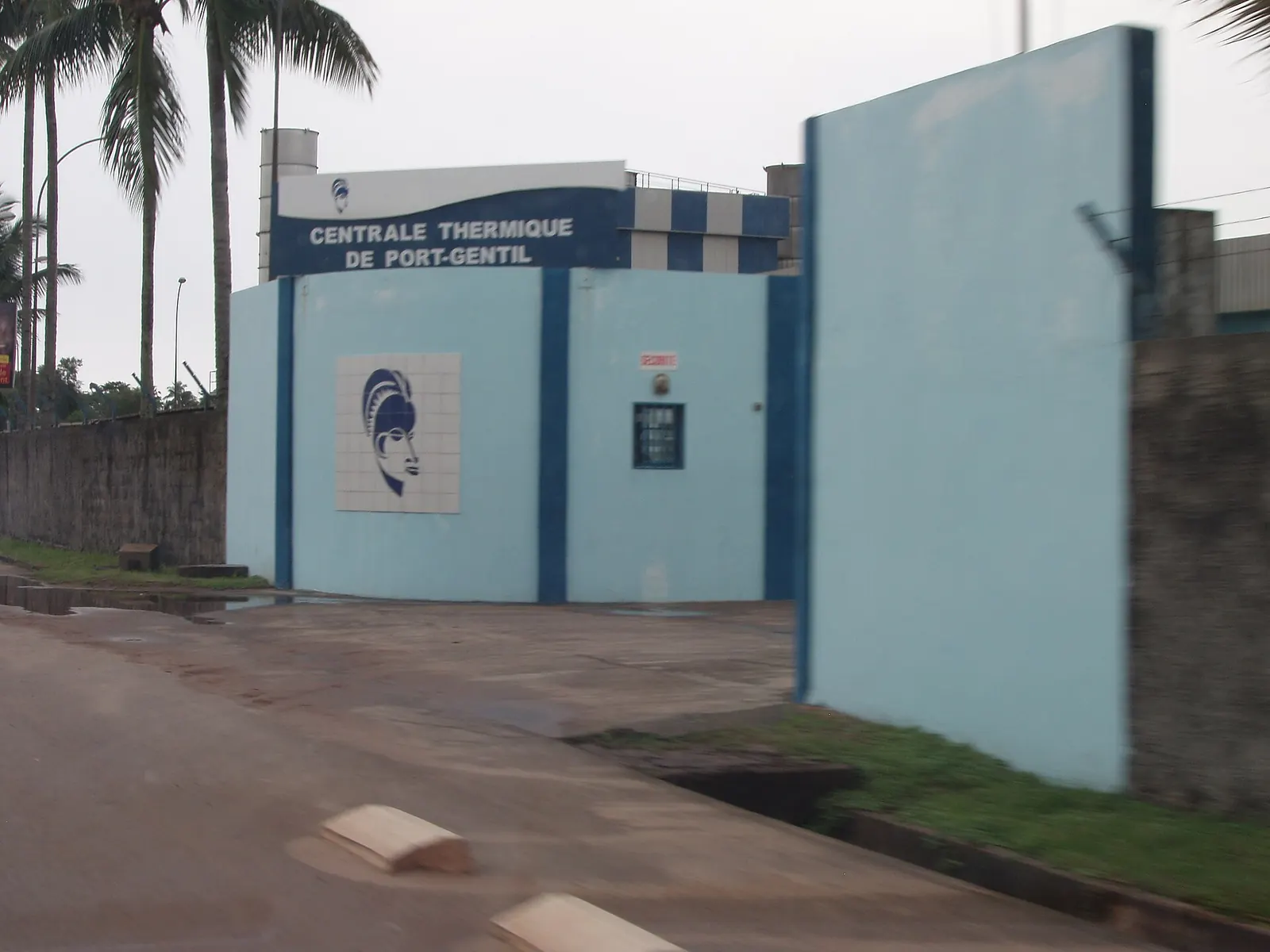
According to the World Bank, 95.1% of the population had access to electricity in 2024, but frequent outages and poor service quality limit the benefits, and access does not exceed 29% in rural areas. Consumption nearly doubled between 2010 and 2024, according to SEEG's interim administrator quoted by AFP. In 2023 hydropower supplied 46.2% of generation, the rest coming from thermal plants. Perenco's gas fuels the plants that generate 70% of Libreville's electricity and all of Port-Gentil's.
To tackle load shedding, the State signed an agreement with Turkish company Karpowership in February 2025 for 150 megawatts (MW) from two floating plants serving Greater Libreville. The same month the grids of Gabon and Equatorial Guinea were interconnected to strengthen supply in the north of the country. The Directorate General for the Economy and Fiscal Policy (DGEPF) reports a 26.4% rise in electricity generation in 2025, driven by the Société de patrimoine and the start of Karpowership's output. Breakdowns linked to a lack of maintenance funding nevertheless caused new load shedding: output fell 8.3% in the fourth quarter of 2025, then 20.1% year on year in the first quarter of 2026 according to Gabonmediatime.
Reforms and new projects
On 15 June 2026 President Brice Clotaire Oligui Nguema announced a thorough reorganisation of SEEG, separating water from electricity and splitting generation, distribution and retail. In February 2026 the World Bank approved USD 150 million for the Access to Basic Services and Performance Improvement Project (PASBAP), expected to benefit about 535,000 people, in line with the National Development Plan (PND) 2025-2032 and the Mission 300 initiative.
Several hydropower projects are led by independent producers partnered with Gabon Power Company, a subsidiary of the Gabonese Strategic Investment Fund. The Kinguélé Aval dam (34.1 MW), developed by Asonha Énergie (Meridiam 60%, Gabon Power Company 40%), is to cover more than 10% of Libreville's needs from the third quarter of 2026. The Ngoulmendjim project (82 MW), led by Eranove and Gabon Power Company, had commissioning announced for 2028. In the south, a 21 MW gas-fired plant is planned at Mayumba with Perenco.
Access to electricity
Total and rural population, %
Access to electricity (Gabon) went from 73.6% in 2000 to 95.1% in 2024. Access to electricity, rural (Gabon) went from 11.6% in 2000 to 51.3% in 2024.
| Period | Access to electricity (%) | Access to electricity, rural (%) |
|---|---|---|
| 2000 | 73.6 | 11.6 |
| 2001 | 77.2 | 21.5 |
| 2002 | 77.8 | 21.0 |
| 2003 | 78.5 | 20.6 |
| 2004 | 79.2 | 20.1 |
| 2005 | 81.6 | 27.1 |
| 2006 | 80.5 | 19.2 |
| 2007 | 81.3 | 18.7 |
| 2008 | 82.0 | 18.3 |
| 2009 | 82.7 | 17.9 |
| 2010 | 89.3 | 50.0 |
| 2011 | 88.7 | 42.4 |
| 2012 | 89.3 | 32.3 |
| 2013 | 86.4 | 32.8 |
| 2014 | 87.1 | 19.8 |
| 2015 | 87.3 | 18.1 |
| 2016 | 88.1 | 18.9 |
| 2017 | 86.3 | n/a |
| 2018 | 89.6 | 21.3 |
| 2019 | 90.3 | 22.8 |
| 2020 | 91.1 | 24.7 |
| 2021 | 91.8 | 26.8 |
| 2022 | 93.5 | 29.0 |
| 2023 | 94.1 | 29.0 |
| 2024 | 95.1 | 51.3 |
n/a: not available.
Hydropower and renewable share
% of electricity generation
Hydropower share of electricity generation (Gabon) went from 61.1% in 2000 to 35.0% in 2024. The highest value was reached in 2001 (62.1%). Renewable share of electricity generation (Gabon) went from 61.8% in 2000 to 35.4% in 2024. The highest value was reached in 2001 (62.9%).
| Period | Hydropower share of electricity generation (%) | Renewable share of electricity generation (%) |
|---|---|---|
| 2000 | 61.1 | 61.8 |
| 2001 | 62.1 | 62.9 |
| 2002 | 61.9 | 62.6 |
| 2003 | 58.2 | 58.8 |
| 2004 | 57.5 | 58.2 |
| 2005 | 51.0 | 51.6 |
| 2006 | 56.6 | 57.2 |
| 2007 | 45.7 | 46.2 |
| 2008 | 48.6 | 49.2 |
| 2009 | 51.4 | 51.9 |
| 2010 | 46.6 | 47.2 |
| 2011 | 40.9 | 41.4 |
| 2012 | 41.7 | 42.1 |
| 2013 | 44.5 | 45.0 |
| 2014 | 39.7 | 40.2 |
| 2015 | 42.9 | 43.4 |
| 2016 | 37.4 | 37.9 |
| 2017 | 41.5 | 42.0 |
| 2018 | 46.8 | 47.1 |
| 2019 | 46.1 | 46.5 |
| 2020 | 48.5 | 48.8 |
| 2021 | 46.3 | 46.6 |
| 2022 | 47.6 | 48.0 |
| 2023 | 35.1 | 35.5 |
| 2024 | 35.0 | 35.4 |
Main players
Main energy players
| Name | Activity | Location |
|---|---|---|
| Société d'énergie et d'eau du Gabon (SEEG) | Generation, transmission and distribution of power and water; reorganisation announced in 2026 | Nationwide |
| Société de patrimoine | Power generation, up in 2025 according to the DGEPF | Nationwide |
| Gabon Power Company | Subsidiary of the Gabonese Strategic Investment Fund; partner in the Kinguélé Aval, Ngoulmendjim and Mayumba projects | Libreville |
| Asonha Énergie (Meridiam, Gabon Power Company) | Kinguélé Aval dam, 34.1 MW; built by Sinohydro | Mbei River (Estuaire) |
| Eranove | Ngoulmendjim hydropower project, 82 MW, with Gabon Power Company | Estuaire |
| Karpowership | Two floating power plants, 150 MW, for Greater Libreville | Libreville (Estuaire) |
| Perenco Oil & Gas Gabon | Gas supply to Libreville and Port-Gentil power plants; Mayumba project | Estuaire, Ogooué-Maritime, Nyanga |
| Regulatory agency for drinking water and electricity (ARSEE) | Sector regulation | Libreville |
Regulatory framework
The sector is governed by Law No. 24/2016 of 29 December 2016 on the legal regime for the generation, transmission and distribution of electricity and drinking water. It guarantees a right of access to electricity and water and places these activities under a State monopoly, which the State may delegate to Gabonese legal entities through concessions, leases, managed operations or public-private partnerships. This is the legal basis for independent power producers such as Asonha Énergie, whose concession contract for Kinguélé Aval was signed in October 2019.
Regulation is carried out by the Regulatory Agency for Drinking Water and Electricity (ARSEE), created by Ordinance No. 019/PR/2010 of 25 February 2010. The SEEG reorganisation announced in June 2026 is to separate water from electricity and split generation, distribution and retail functions. Generation projects are subject to the 2014 environmental protection law.
Reference texts
-
Electricity and drinking water law
Loi n° 24/2016 du 29 décembre 2016 fixant le régime juridique de la production, du transport et de la distribution de l'énergie électrique et de l'eau potable en République gabonaise
-
Ordinance creating the water and electricity regulator
Ordonnance n° 019/PR/2010 du 25 février 2010 portant création, attributions, organisation et fonctionnement de l'Agence de régulation du secteur de l'eau potable et de l'énergie électrique en République gabonaise
-
Environmental protection law
Loi n° 007/2014 du 01 août 2014 relative à la protection de l'environnement en République gabonaise
Opportunities
- Independent generation. The 2016 framework allows concessions and public-private partnerships; the Kinguélé Aval and Ngoulmendjim projects illustrate the model pairing a private developer with Gabon Power Company. The country's hydropower potential is estimated at about 6,000 MW.
- Gas-to-power. Associated gas that is now flared can fuel power plants, as in Mayumba, replacing diesel generators.
- Grids and rural electrification. With rural access limited to 29%, grid extension, mini-grids and off-grid solutions are priorities, supported by PASBAP and Mission 300.
- Utility performance. The SEEG reform creates needs in metering, loss reduction, maintenance and management systems.
- Industrial demand. Local manganese processing, steelmaking (Prometal's 70 MW project at Nkok) and the timber industry need reliable and plentiful power.
Take the next step
These opportunities translate into concrete formalities: find the ones that apply to your project, or ask the assistant.
Documents
-
World Bank, PASBAP project (press release), HTML format (opens in a new tab)
Banque mondiale
-
World Bank, Macro Poverty Outlook for Gabon, April 2026, PDF format (opens in a new tab)
Banque mondiale
-
DGEPF, sector business cycle note for the fourth quarter of 2025 (in French), PDF format (opens in a new tab)
Direction générale de l'économie et de la politique fiscale
-
Perenco, Mayumba gas-fired power project (press release), PDF format (opens in a new tab)
Perenco
-
IMF, 2024 Article IV consultation (Country Report No. 24/144), PDF format (opens in a new tab)
Fonds monétaire international
Sources
14 sources cited
Documents and datasets used for this profile.
- Access to electricity (% of population), Gabon (opens in a new tab)
- Electricity production from hydroelectric sources (% of total), Gabon (opens in a new tab)
- World Bank supports Gabon's water supply, sanitation, and electricity services (opens in a new tab)
- Note de conjoncture sectorielle du quatrième trimestre 2025 (opens in a new tab)
- Gabon : chute de 20 % de la production d'électricité au 1er trimestre 2026 (opens in a new tab)
- Électricité : le Gabon lance une réforme de la SEEG (dépêche AFP) (opens in a new tab)
- Visite du chantier du barrage hydroélectrique de Kinguélé Aval et de la carrière de Kinguélé (opens in a new tab)
- Kinguélé Aval Hydroelectric Power Station (opens in a new tab)
- Ngoulmendjim Hydroelectric Power Station (opens in a new tab)
- Perenco Oil & Gas Gabon supports major energy infrastructure project in Gabon (opens in a new tab)
- Le groupe Prometal investit 150 milliards FCFA pour industrialiser le Gabon (opens in a new tab)
- Économie du Gabon (opens in a new tab)
- World Bank (opens in a new tab) Access to electricity, Access to electricity, rural
- Our World in Data (opens in a new tab) Electricity generation, Hydropower share of electricity generation, Renewable share of electricity generation