Industry and processing
Agro-industry
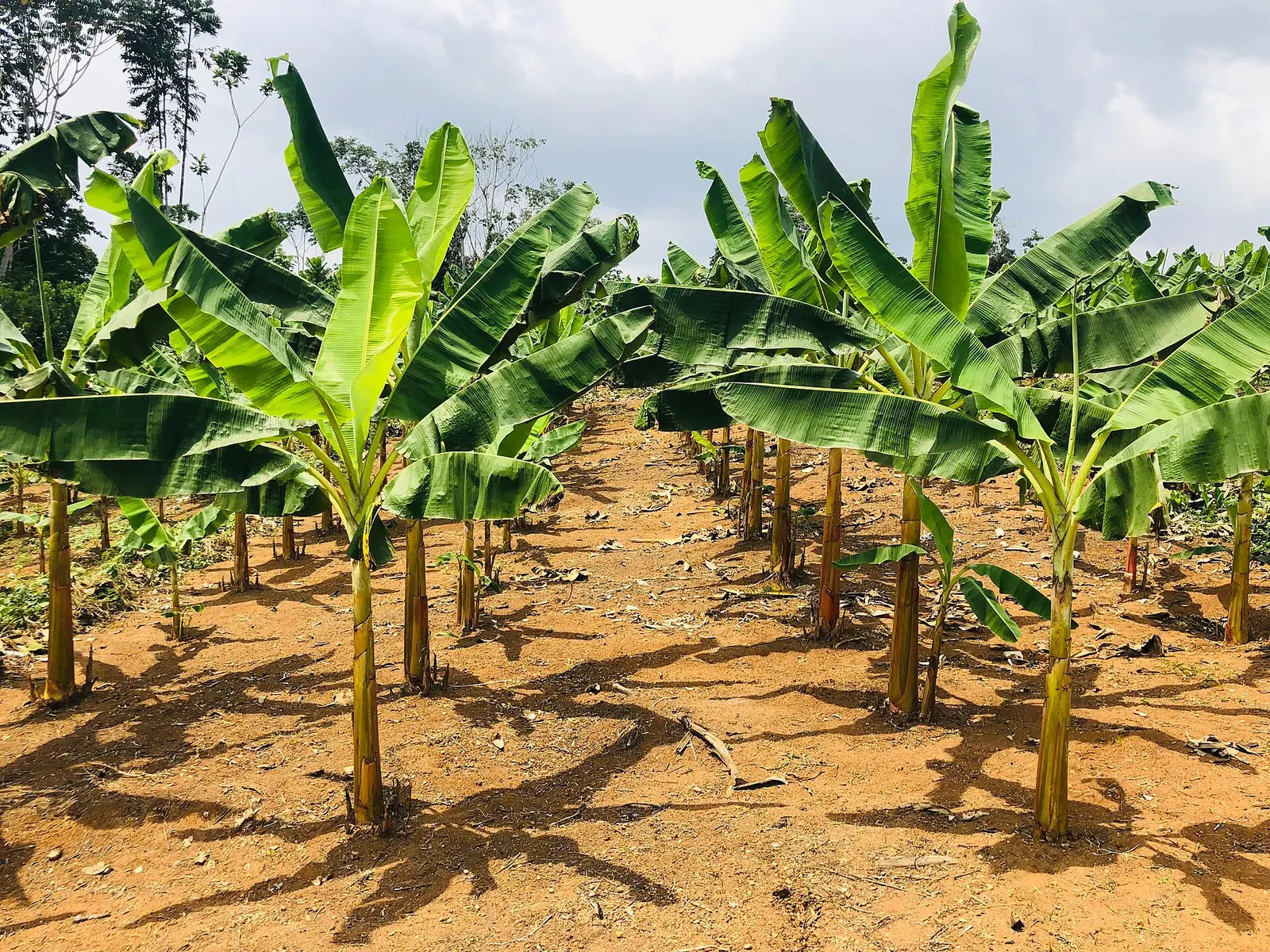
Gabon's agro-industry rests on industrial oil palm and rubber plantations, developed since 2011 through a partnership between the State and the Olam group, and on food processing (oils, beverages, flour). Palm oil has become a regional export, but plantation yields and dependence on food imports remain challenges.
- Palm fruit bunches harvested
- 559,211tonnes (-9.5%)
- Crude palm oil production
- 136,852tonnes (-6.5%)
- Palm oil exports
- 127,684tonnes (+21.9%)
Source: Gabon : le secteur d'huile de palme en recul de 9,5 % en 2024
Key figures
Agro-industry key figures
Palm fruit bunches harvested
559,211 tonnes (-9.5%)
2024
Crude palm oil production
136,852 tonnes (-6.5%)
2024
Palm oil exports
127,684 tonnes (+21.9%)
2024
Olam Palm Gabon oil palm area
70,000 hectares
2025
Jobs linked to Olam Palm Gabon
12,000 of which 5,000 direct
2025
Cash crop output
+1.6 % year on year (palm +1.1%, rubber +2.7%)
2025
Soft drink and alcoholic beverage output
+6.5 % year on year
2025
Food imports
450 billion CFA francs per year
Estimation
Statistical series
Agriculture, forestry and fishing value added
6.8 % of GDP
2025
Source: World Bank
15.7 %
2023
Source: World Bank
3.9 %
2023
Source: World Bank
Locations
- Scale
- Nationwide
Source: OCHA / Institut national de cartographie du Gabon (CC BY-IGO)
Trends
Palm oil: an export sector with fragile yields
In 2011, according to Gabonmediatime, the State set up the Olam Palm Gabon joint venture with Singapore-based Olam, in which it holds 40%. Concessions of 198,000 hectares were allocated and about 291 billion CFA francs invested. The company operates about 70,000 hectares of oil palm in Estuaire (Awala mill), Ngounié (Mouila) and Moyen-Ogooué, and employs some 12,000 people, 5,000 of them directly. Certified by the Roundtable on Sustainable Palm Oil (RSPO), it exports about 50,000 tonnes of crude oil a year to Cameroon and supplies refined oil to the domestic market.
According to the Directorate General for the Economy and Fiscal Policy (DGEPF), cited by Gabonmediatime, the bunch harvest fell 9.5% in 2024 to 559,211 tonnes and crude oil output 6.5% to 136,852 tonnes, because of wildlife damage and insufficient rainfall at Mouila and Awala. Exports nevertheless rose 21.9%. In 2025 bunch production edged up (+1.1%), despite a 26.4% fall in the fourth quarter linked to the closure of the Pangani site in Mandji, where yields had collapsed and elephant intrusions were constant. In the first quarter of 2026 palm output fell a further 8.7% year on year according to Gabonmediatime.
Rubber, the GRAINE programme and food processing
Natural rubber is produced notably by Olam Rubber Gabon (ORG) in Woleu-Ntem. Output rose 2.7% in 2025, then 15.2% year on year in the first quarter of 2026 according to Gabonmediatime, thanks to strong results at ORG and the gradual recovery of another operator. In July 2026 ORG renewed its purchase contract with the village rubber growers' cooperative in Bitam.
Launched in 2014, the GRAINE programme (Gabonaise des réalisations agricoles et des initiatives des nationaux engagés) aimed to involve national cooperatives in cash crop value chains, with Olam as operator. Its ambitions were scaled back from 2019, amid heavy costs linked to equipment acquired in 2015 by SOTRADER, the Gabonese agricultural processing and rural development company in charge of managing it.
In food processing, the DGEPF reports for 2025 a 6.5% rise in beverage output, a 4.5% fall in flour and stable cooking oil output. The World Bank expects palm oil and rubber to support growth in 2026-2028, and the government has announced a ban on broiler chicken imports from 2027 to develop local production.
Agriculture, forestry and fishing value added
Agriculture, forestry and fishing value added (Gabon) went from 32.2 % of GDP in 1960 to 6.8 % of GDP in 2025. The highest value was reached in 1963 (44.1 % of GDP).
| Period | Agriculture, forestry and fishing value added (% of GDP) |
|---|---|
| 1960 | 32.2 |
| 1961 | 35.2 |
| 1962 | 35.9 |
| 1963 | 44.1 |
| 1964 | 30.2 |
| 1965 | 26.3 |
| 1966 | 25.2 |
| 1967 | 24.1 |
| 1968 | 18.4 |
| 1969 | 18.6 |
| 1970 | 18.5 |
| 1971 | 13.8 |
| 1972 | 13.1 |
| 1973 | 11.6 |
| 1974 | 8.2 |
| 1975 | 6.4 |
| 1976 | 5.0 |
| 1977 | 5.5 |
| 1978 | 6.5 |
| 1979 | 7.4 |
| 1980 | 6.8 |
| 1981 | 6.1 |
| 1982 | 6.1 |
| 1983 | 6.5 |
| 1984 | 6.1 |
| 1985 | 6.8 |
| 1986 | 9.2 |
| 1987 | 11.0 |
| 1988 | 10.1 |
| 1989 | 8.7 |
| 1990 | 7.3 |
| 1991 | 7.6 |
| 1992 | 8.3 |
| 1993 | 8.5 |
| 1994 | 9.1 |
| 1995 | 8.0 |
| 1996 | 7.1 |
| 1997 | 7.2 |
| 1998 | 7.0 |
| 1999 | 7.3 |
| 2000 | 6.2 |
| 2001 | 6.1 |
| 2002 | 5.7 |
| 2003 | 6.0 |
| 2004 | 5.5 |
| 2005 | 5.0 |
| 2006 | 4.9 |
| 2007 | 5.0 |
| 2008 | 4.2 |
| 2009 | 5.0 |
| 2010 | 3.9 |
| 2011 | 3.4 |
| 2012 | 3.4 |
| 2013 | 3.3 |
| 2014 | 3.6 |
| 2015 | 4.3 |
| 2016 | 5.0 |
| 2017 | 5.3 |
| 2018 | 5.4 |
| 2019 | 5.6 |
| 2020 | 6.6 |
| 2021 | 6.8 |
| 2022 | 6.5 |
| 2023 | 6.7 |
| 2024 | 6.6 |
| 2025 | 6.8 |
Food share of merchandise imports
Food share of merchandise imports (Gabon) went from 21.7% in 1962 to 15.7% in 2023. The highest value was reached in 2004 (24.2%).
| Period | Food share of merchandise imports (%) |
|---|---|
| 1962 | 21.7 |
| 1963 | 18.3 |
| 1964 | 18.1 |
| 1965 | 16.0 |
| 1966 | 15.3 |
| 1967 | 15.6 |
| 1968 | 16.9 |
| 1969 | 14.4 |
| 1970 | 14.3 |
| 1971 | 14.0 |
| 1975 | 13.1 |
| 1976 | 11.7 |
| 1977 | 11.3 |
| 1978 | 19.4 |
| 1979 | 19.0 |
| 1980 | 19.1 |
| 1981 | 16.0 |
| 1982 | 16.7 |
| 1983 | 18.0 |
| 1993 | 19.4 |
| 1994 | 17.3 |
| 1996 | 19.1 |
| 1997 | 17.6 |
| 1998 | 15.4 |
| 1999 | 19.2 |
| 2000 | 18.2 |
| 2001 | 18.3 |
| 2002 | 15.9 |
| 2003 | 15.0 |
| 2004 | 24.2 |
| 2005 | 19.1 |
| 2006 | 16.6 |
| 2007 | 18.1 |
| 2008 | 17.5 |
| 2009 | 17.1 |
| 2010 | 15.7 |
| 2011 | 18.5 |
| 2012 | 9.3 |
| 2013 | 9.6 |
| 2014 | 6.3 |
| 2015 | 8.9 |
| 2016 | 11.0 |
| 2017 | 14.8 |
| 2018 | 16.4 |
| 2019 | 14.3 |
| 2020 | 16.6 |
| 2021 | 16.9 |
| 2022 | 15.3 |
| 2023 | 15.7 |
Agricultural raw materials share of exports
Agricultural raw materials share of exports (Gabon) went from 47.8% in 1962 to 3.9% in 2023.
| Period | Agricultural raw materials share of exports (%) |
|---|---|
| 1962 | 47.8 |
| 1963 | 41.1 |
| 1964 | 40.8 |
| 1965 | 35.0 |
| 1966 | 32.5 |
| 1967 | 26.1 |
| 1968 | 29.1 |
| 1969 | 31.2 |
| 1970 | 33.0 |
| 1971 | 24.0 |
| 1975 | 5.6 |
| 1976 | 7.9 |
| 1977 | 6.8 |
| 1978 | 7.6 |
| 1979 | 6.1 |
| 1981 | 6.8 |
| 1982 | 6.2 |
| 1983 | 7.1 |
| 1993 | 3.0 |
| 1994 | 8.8 |
| 1996 | 13.1 |
| 1997 | 13.5 |
| 1998 | 9.7 |
| 1999 | 13.1 |
| 2000 | 11.8 |
| 2001 | 11.1 |
| 2002 | 9.3 |
| 2003 | 5.5 |
| 2004 | 9.8 |
| 2005 | 7.5 |
| 2006 | 6.7 |
| 2007 | 8.4 |
| 2008 | 5.6 |
| 2009 | 8.9 |
| 2010 | 3.6 |
| 2011 | 4.8 |
| 2012 | 1.8 |
| 2013 | 1.6 |
| 2014 | 1.7 |
| 2015 | 2.2 |
| 2016 | 3.7 |
| 2017 | 6.1 |
| 2018 | 4.8 |
| 2019 | 4.8 |
| 2020 | 6.5 |
| 2021 | 5.9 |
| 2022 | 4.8 |
| 2023 | 3.9 |
Main players
Main agro-industry players
| Name | Activity | Location |
|---|---|---|
| Olam Palm Gabon | Oil palm plantations, oil mill, refining; State holds 40% | Estuaire (Awala), Ngounié (Mouila), Moyen-Ogooué |
| Olam Rubber Gabon (ORG) | Rubber plantations, rubber purchases from village growers | Bitam (Woleu-Ntem) |
| SIAT | Agro-industrial group operating in Gabon | Gabon |
| SOTRADER | Public agricultural processing and rural development company, manager of the GRAINE programme | Libreville and provinces |
| Gabon village rubber growers' cooperative | Rubber supply to ORG | Bitam (Woleu-Ntem) |
| Sobraga (Castel group) | Brewing and beverages | Gabon |
Source: Gabon : 50 000 tonnes d'huile brute exportées chaque année vers le Cameroun (opens in a new tab)
Regulatory framework
Agricultural investment is governed by the agricultural code (Law No. 022/2008 of 10 December 2008), which provides investment aid, easier access to credit and tax and customs incentives, extended in 2013, for farmers holding a technical approval. Law No. 023/2008 of the same date sets the sustainable agricultural development policy, with food self-sufficiency and export diversification goals.
Industrial plantations are subject to the 2014 environmental protection law, which requires impact assessments. Investors benefit from the guarantees of the 1998 investment charter. The ban on broiler chicken imports from 1 January 2027, announced in May 2025, adds to the tools protecting local production. Olam Palm Gabon's RSPO certification is voluntary.
Reference texts
-
Agricultural code
Loi n° 022/2008 du 10 décembre 2008 portant code agricole en République gabonaise
-
Sustainable agricultural development policy law
Loi n° 023/2008 du 10 décembre 2008 portant politique de développement agricole durable
-
Environmental protection law
Loi n° 007/2014 du 01 août 2014 relative à la protection de l'environnement en République gabonaise
-
Investment charter
Loi n° 15/98 du 23 juillet 1998 instituant la Charte des investissements en République gabonaise
Opportunities
- Import substitution. Gabon imports about 450 billion CFA francs of food a year. Poultry, animal feed, food crop processing and milling meet large domestic demand.
- Poultry. The 2027 ban on broiler chicken imports opens a market for local producers, provided farms are modernised and feed supply secured.
- Palm oil value added. Refining, soap-making and derived products capture more value, in a regional market with a deficit such as Cameroon.
- Rubber and village plantations. Purchase contracts between ORG and village growers offer a contract-farming model that can be applied to other crops.
- Plantation productivity. Falling yields and wildlife damage call for investment in replanting, agronomy and crop protection.
Take the next step
These opportunities translate into concrete formalities: find the ones that apply to your project, or ask the assistant.
Documents
-
DGEPF, sector business cycle note for the fourth quarter of 2025 (in French), PDF format (opens in a new tab)
Direction générale de l'économie et de la politique fiscale
-
World Bank, Macro Poverty Outlook for Gabon, April 2026, PDF format (opens in a new tab)
Banque mondiale
-
IMF, 2024 Article IV consultation (Country Report No. 24/144), PDF format (opens in a new tab)
Fonds monétaire international
-
Country commercial guide: agriculture, HTML format (opens in a new tab)
International Trade Administration
Sources
13 sources cited
Documents and datasets used for this profile.
- Gabon : le secteur d'huile de palme en recul de 9,5 % en 2024 (opens in a new tab)
- Gabon : 50 000 tonnes d'huile brute exportées chaque année vers le Cameroun (opens in a new tab)
- Filière oléagineuse : comment le Gabon est devenu le géant sous-régional de l'huile de palme (opens in a new tab)
- Gabon : Olam Rubber renouvelle son partenariat avec les planteurs villageois d'hévéa (opens in a new tab)
- Gabon : l'agriculture de rente baisse de 0,8 % au premier trimestre 2026 (opens in a new tab)
- SOTRADER : où sont passés les 400 bulldozers et 75 pelleteuses du programme GRAINE ? (opens in a new tab)
- Note de conjoncture sectorielle du quatrième trimestre 2025 (opens in a new tab)
- Gabon Country Commercial Guide: Agriculture (opens in a new tab)
- SIAT, site officiel (opens in a new tab)
- Macro Poverty Outlook for Gabon, April 2026 (opens in a new tab)
- Gabon: 2024 Article IV Consultation, Country Report No. 24/144 (opens in a new tab)
- Économie du Gabon (opens in a new tab)
- World Bank (opens in a new tab) Agriculture, forestry and fishing value added, Food share of merchandise imports, Agricultural raw materials share of exports