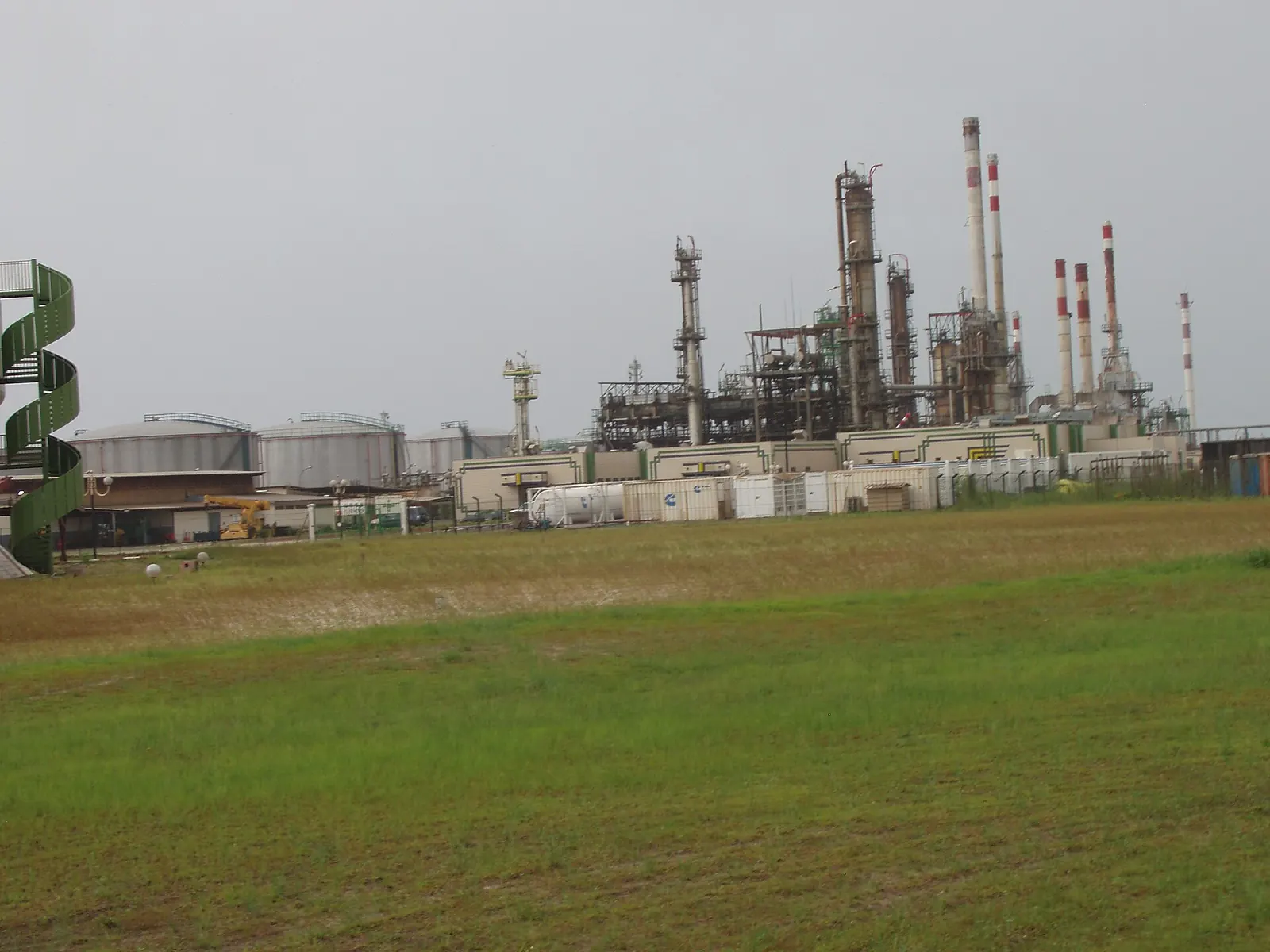
Mining, gas and hydrocarbons
Oil
Oil remains Gabon's leading export and the main source of government revenue. Output comes from mature onshore and shallow-water fields and hovers around 11 million tonnes a year. The State is expanding its role through Gabon Oil Company and seeks to revive exploration, especially in deep offshore areas.
- Crude oil production
- 84.0million barrels (11.5 million tonnes)
- Average daily output
- about 230,000barrels per day
- Crude oil production
- -2.9% year on year
Detailed sources in the key figures below.
Key figures
Oil output and weight in the economy
Crude oil production
84.0 million barrels (11.5 million tonnes)
2024
Average daily output
about 230,
2024
Crude oil production
-2.9 % year on year
2025
First-quarter output
2.6 million tonnes (-8.7% year on year)
T1 2026
39 %
2023 (estimation FMI)
50 %
2023 (estimation FMI)
68 %
2023 (estimation FMI)
Statistical series
Crude oil production
227.0 kbbl/d
2025
Source: Organization of the Petroleum Exporting Countries
Oil rents
15.6 % of GDP
2021
Source: World Bank
54.0 %
2023
Source: World Bank
Locations
- 2 provinces
- Nyanga, Ogooué-Maritime
Source: OCHA / Institut national de cartographie du Gabon (CC BY-IGO)
Provinces of the listed sites: oil terminal.
Trends
Output has stabilised but remains under pressure
The International Monetary Fund (IMF) notes that Gabon ranks among the world's top ten countries for oil output per capita, but that its proven and probable reserves could be exhausted around mid-century in the absence of new discoveries. According to the Directorate General of Hydrocarbons (DGH), cited by Financial Afrik, it reached 84 million barrels in 2024, or 11.5 million tonnes, up 3.1% from 2023 (81.4 million barrels).
For 2025, the Directorate General for the Economy and Fiscal Policy (DGEPF) reports a 2.9% decline, while operators had expected a 3% increase. After three consecutive quarterly declines, output rebounded 1.6% in the fourth quarter thanks to better availability of surface equipment and field optimisation. Early 2026 was difficult: according to Gabonmediatime, first-quarter output (2.6 million tonnes) fell 8.7% year on year because of planned shutdowns, breakdowns and the explosion of a key pipeline.
A reshaped operator landscape
The State has markedly increased its role as an operator. The national oil company, Gabon Oil Company (GOC), completed in June 2024, with financing from trader Gunvor, the purchase of Assala Energy, whose output was around 45,000 barrels per day. In July 2025 it closed the acquisition of Tullow Oil Gabon for USD 307 million, ending 21 years of Tullow's presence. GOC also holds 9% of the Dussafu licence.
Private operators keep redeveloping existing fields. BW Energy averaged 33,200 barrels per day (gross) at Dussafu in 2025 and took the investment decision on the Bourdon field in May 2025, targeting first oil in the first quarter of 2028. Vaalco launched a new drilling campaign on Etame Marin, with wells brought on stream in 2026. TotalEnergies EP Gabon, now focused on its operated Anguille and Torpille assets, produced 16,000 barrels per day in 2025, down 6%. Maurel & Prom expects 14,800 barrels per day net to its share on the Ezanga licence in 2026.
Financing and exploration
In April 2026, according to Reuters as cited by Gabonmediatime, the State signed a USD 1 billion, seven-year prefinancing agreement with Trafigura, repaid through future crude deliveries; Trafigura becomes the exclusive buyer of the State's share of production (profit oil). Meanwhile, the Ministry of Petroleum and Gas states, according to Gabonreview, that only 27.5% of the petroleum domain is under production licences and that about 72% of the territory remains unexplored, particularly in deep and ultra-deep waters.
Oil and gas production
Energy content in terawatt hours
Oil production (energy content) (Gabon) went from 156.92 TWh in 1990 to 131.82 TWh in 2025. The highest value was reached in 1996 (212.25 TWh). Natural gas production (energy content) (Gabon) went from 0.92 TWh in 1990 to 5.17 TWh in 2024. The highest value was reached in 2018 (5.74 TWh).
| Period | Oil production (energy content) (TWh) | Natural gas production (energy content) (TWh) |
|---|---|---|
| 1990 | 156.92 | 0.92 |
| 1991 | 171.05 | 1.09 |
| 1992 | 168.08 | 1.08 |
| 1993 | 177.04 | 1.08 |
| 1994 | 195.81 | 1.08 |
| 1995 | 206.50 | 1.08 |
| 1996 | 212.25 | 1.08 |
| 1997 | 211.60 | 1.08 |
| 1998 | 195.94 | 1.08 |
| 1999 | 197.42 | 1.08 |
| 2000 | 160.71 | 0.87 |
| 2001 | 152.14 | 0.87 |
| 2002 | 148.66 | 0.98 |
| 2003 | 159.11 | 0.98 |
| 2004 | 158.97 | 1.08 |
| 2005 | 156.98 | 1.08 |
| 2006 | 140.50 | 1.08 |
| 2007 | 142.60 | 0.87 |
| 2008 | 139.50 | 0.87 |
| 2009 | 139.95 | 0.87 |
| 2010 | 135.42 | 0.87 |
| 2011 | 137.21 | 0.76 |
| 2012 | 128.77 | 4.17 |
| 2013 | 123.93 | 3.45 |
| 2014 | 122.47 | 4.55 |
| 2015 | 124.00 | 4.10 |
| 2016 | 128.49 | 4.11 |
| 2017 | 121.99 | 5.28 |
| 2018 | 112.34 | 5.74 |
| 2019 | 126.50 | 5.03 |
| 2020 | 120.78 | 5.44 |
| 2021 | 105.21 | 4.92 |
| 2022 | 110.65 | 5.02 |
| 2023 | 129.62 | 5.02 |
| 2024 | 130.24 | 5.17 |
| 2025 | 131.82 | n/a |
n/a: not available.
Crude oil production
Crude oil production (Gabon) went from 241.0 kbbl/d in 2010 to 227.0 kbbl/d in 2025. The highest value was reached in 2011 (251.0 kbbl/d).
| Period | Crude oil production (kbbl/d) |
|---|---|
| 2010 | 241.0 |
| 2011 | 251.0 |
| 2012 | 242.0 |
| 2013 | 234.1 |
| 2014 | 210.9 |
| 2015 | 213.5 |
| 2016 | 220.7 |
| 2017 | 210.1 |
| 2018 | 193.4 |
| 2019 | 218.0 |
| 2020 | 207.0 |
| 2021 | 181.0 |
| 2022 | 191.0 |
| 2023 | 223.0 |
| 2024 | 222.0 |
| 2025 | 227.0 |
Oil rents
Oil rents (Gabon) went from 2.8 % of GDP in 1970 to 15.6 % of GDP in 2021. The highest value was reached in 1979 (53.9 % of GDP).
| Period | Oil rents (% of GDP) |
|---|---|
| 1970 | 2.8 |
| 1971 | 1.0 |
| 1972 | 3.4 |
| 1973 | 4.3 |
| 1974 | 39.0 |
| 1975 | 29.6 |
| 1976 | 21.3 |
| 1977 | 27.2 |
| 1978 | 27.6 |
| 1979 | 53.9 |
| 1980 | 32.5 |
| 1981 | 18.0 |
| 1982 | 7.5 |
| 1983 | 16.7 |
| 1984 | 20.1 |
| 1985 | 23.6 |
| 1986 | 7.7 |
| 1987 | 16.0 |
| 1988 | 11.6 |
| 1989 | 24.5 |
| 1990 | 30.6 |
| 1991 | 20.0 |
| 1992 | 23.0 |
| 1993 | 28.6 |
| 1994 | 26.3 |
| 1995 | 27.4 |
| 1996 | 29.2 |
| 1997 | 29.8 |
| 1998 | 15.5 |
| 1999 | 22.0 |
| 2000 | 43.7 |
| 2001 | 28.6 |
| 2002 | 27.2 |
| 2003 | 21.3 |
| 2004 | 25.1 |
| 2005 | 34.8 |
| 2006 | 33.9 |
| 2007 | 34.3 |
| 2008 | 37.2 |
| 2009 | 24.6 |
| 2010 | 33.5 |
| 2011 | 37.4 |
| 2012 | 38.3 |
| 2013 | 30.2 |
| 2014 | 22.2 |
| 2015 | 10.0 |
| 2016 | 9.0 |
| 2017 | 14.4 |
| 2018 | 18.3 |
| 2019 | 16.7 |
| 2020 | 10.0 |
| 2021 | 15.6 |
Main players
Main players in the oil sector
| Name | Activity | Location |
|---|---|---|
| Perenco Oil & Gas Gabon | Largest producer in the country, about 110,000 barrels of oil equivalent per day (2023); sole commercial gas producer | Onshore and offshore, Ogooué-Maritime (Port-Gentil) |
| Gabon Oil Company (GOC) | National oil company; owner of Assala Energy since 2024 and Tullow Oil Gabon since 2025 | Libreville; onshore and offshore licences |
| Assala Energy | Onshore production, about 45,000 barrels per day when acquired by GOC (2024) | Onshore |
| TotalEnergies EP Gabon | Operates the Anguille and Torpille areas, 16,000 barrels per day in 2025 | Offshore, off Port-Gentil |
| BW Energy | Operator (73.5%) of the Dussafu licence, 33,200 gross barrels per day in 2025; Bourdon project | Offshore (Dussafu) |
| Panoro Energy | 17.5% partner in the Dussafu licence | Offshore (Dussafu) |
| Vaalco Energy | Operator (58.8%) of the Etame Marin block, 2025-2026 drilling campaign | Offshore, about 30 km from the coast |
| Maurel & Prom | Operator (80%) of the Ezanga licence, 14,800 barrels per day expected net in 2026 | Onshore (Ezanga) |
| Trafigura | Exclusive buyer of the State's profit oil under a prefinancing deal signed in 2026 | International |
| Ministry of Petroleum and Gas, Directorate General of Hydrocarbons (DGH) | Oversight, licensing, production monitoring | Libreville |
Source: Rapports et communiqués des opérateurs, 2023-2026 (voir sources) (opens in a new tab)
Regulatory framework
The upstream oil sector is governed by the hydrocarbons code (Law No. 002/2019 of 16 July 2019), drafted after broad consultation with lawyers, academics and tax experts to make the country more attractive to investors. It sets out operators' rights and obligations and the tax, customs and foreign exchange regimes of petroleum contracts, and includes provisions on local content and natural gas use. It repealed Law No. 11/2014 of 28 August 2014, which provided for a minimum 20% State stake in projects plus a 15% entitlement for Gabon Oil Company.
Production is mainly governed by production sharing contracts: once their costs are recovered, operators share the profit oil with the State. Resident extractive companies are also subject to the Central African Economic and Monetary Community (CEMAC) regulation of December 2021 on applying foreign exchange rules to the extractive sector, notably regarding the domiciliation and repatriation of export proceeds.
Gabon joined the Extractive Industries Transparency Initiative (EITI) on 21 October 2021, after being delisted in 2013. Its 2025 validation assessed moderate progress (73.5 points). Gabon is a member of the Organization of the Petroleum Exporting Countries (OPEC), which it rejoined in July 2016.
Reference texts
-
Hydrocarbons code
Loi n° 002/2019 du 16 juillet 2019 portant réglementation du secteur des hydrocarbures en République gabonaise
-
Regulation on how resident extractive companies apply certain foreign exchange rules
Règlement n° 01/CEMAC/UMAC/CM, fait à Douala le 23 décembre 2021
Opportunities
- Deep and ultra-deep offshore exploration. With about 72% of the domain unexplored, the government has made stepping up exploration in these areas a priority, relying on international partners.
- Redevelopment of mature fields. Drilling campaigns by Vaalco, BW Energy and Maurel & Prom show the value of infill wells, sidetracks and satellite discoveries tied back to existing facilities.
- Oilfield services and local content. Ongoing projects, such as construction work awarded to the Port-Gentil yard for the Cap Lopez liquefied natural gas project, open markets to service and fabrication companies based in Gabon.
- Downstream value. In 2024 the IMF noted the authorities' intention to capture more value by processing more gas and taking strategic upstream positions, a direction confirmed by GOC's acquisitions.
These priorities are part of the National Development Plan (PND) 2025-2032, which aims to use extractive resources to finance economic diversification.
Take the next step
These opportunities translate into concrete formalities: find the ones that apply to your project, or ask the assistant.
Documents
-
Gabon 2023 EITI report, HTML format (opens in a new tab)
ITIE Gabon
-
Gabon 2022 EITI report, HTML format (opens in a new tab)
ITIE Gabon
-
IMF, 2024 Article IV consultation (Country Report No. 24/144), PDF format (opens in a new tab)
Fonds monétaire international
-
World Bank, Macro Poverty Outlook for Gabon, April 2026, PDF format (opens in a new tab)
Banque mondiale
-
DGEPF, sector business cycle note for the fourth quarter of 2025 (in French), PDF format (opens in a new tab)
Direction générale de l'économie et de la politique fiscale
-
Maurel & Prom, 2025 annual results, PDF format (opens in a new tab)
Maurel & Prom
-
Country commercial guide: oil and gas, HTML format (opens in a new tab)
International Trade Administration
Sources
24 sources cited
Documents and datasets used for this profile.
- Gabon : la production des hydrocarbures en hausse de 3 % en 2024 (opens in a new tab)
- Gabon : avec seulement 27,5 % du domaine pétrolier exploité, l'État mise sur une relance intensive (opens in a new tab)
- Note de conjoncture sectorielle du quatrième trimestre 2025 (opens in a new tab)
- Gabon : les industries extractives à la peine au premier trimestre 2026 (opens in a new tab)
- Gabon: 2024 Article IV Consultation, Country Report No. 24/144 (opens in a new tab)
- Gabon National Oil Company partners with Gunvor on Assala Energy acquisition (opens in a new tab)
- Tullow completes sale of Gabon assets to the Gabon Oil Company (opens in a new tab)
- Dussafu (opens in a new tab)
- Gabon operations (opens in a new tab)
- TotalEnergies EP Gabon: 2025 Revenues (opens in a new tab)
- 2025 annual results (opens in a new tab)
- Gabon : l'État sécurise environ 610 milliards de FCFA auprès de Trafigura via un accord pétrolier (opens in a new tab)
- Perenco Oil & Gas Gabon supports major energy infrastructure project in Gabon (opens in a new tab)
- Gabon Country Commercial Guide: Oil and Gas (opens in a new tab)
- Gabon: Oil and Gas (archive) (opens in a new tab)
- Gabon, page pays (opens in a new tab)
- Gabon 2023 EITI Report (opens in a new tab)
- Gabon 2022 EITI Report (opens in a new tab)
- L'industrie pétrolière et gazière du Gabon (opens in a new tab)
- Cap Lopez LNG project in Gabon moves closer to completion (opens in a new tab)
- Macro Poverty Outlook for Gabon, April 2026 (opens in a new tab)
- Organization of the Petroleum Exporting Countries (opens in a new tab) Crude oil production
- World Bank (opens in a new tab) Oil rents, Fuel share of merchandise exports
- Our World in Data (opens in a new tab) Oil production (energy content)